How do we build educational technology that serves liberation rather than surveillance? This session explores “cooperative digital organizing. “Creating community-controlled spaces that prioritize privacy, consent, and collective decision-making over engagement metrics and data extraction.
Drawing on the Initiative for Literacy in a Digital Age’s transition from academic organization to cooperative network, we’ll share what we’re learning about how educational communities can reclaim digital sovereignty. We’ll examine our journey from Google Workspace and social media to privacy-first tools like Nextcloud, Signal, and self-hosted alternatives. Not as technical solutions, but as pedagogical choices.
We’ll explore together:
- Privacy by Design principles for educational communities
- Tool choice as curriculum—how platforms shape learning relationships
- Cooperative governance models for shared decision-making
- Consent-based participation honoring different comfort levels
- Community care infrastructure supporting sustainable organizing
Through case studies from our migration away from extractive platforms. What’s working, what isn’t, what we’re figuring out. We’ll collaborate on creating resilient, trust-centered digital communities. Come ready to share experiments, challenges, and questions about building educational technology serving the community rather than capital.

Session Resources:
Initiative for Literacy in a Digital Age: https://initiativeforliteracy.org/
Privacy by Design Framework: https://en.wikipedia.org/wiki/Privacy_by_design
Nextcloud for Education: https://nextcloud.com/education/
Sian Bayne – Digital sanctuary and anonymity on campus: https://wonkhe.com/blogs/digital-sanctuary-and-anonymity-on-campus/
Amy Collier – Digital Sanctuary: Protection and Refuge on the Web?: https://er.educause.edu/articles/2017/8/digital-sanctuary-protection-and-refuge-on-the-web
Let’s Play Brand Actualization: Selling Out the Open Web
Capitalism and the open web: can these two concepts ever be united? We’ll answer that together as we play Brand Actualization, a role-playing game designed to bring catharsis to anyone who’s ever sat through a terrible meeting and wondered why the hell they were asked to be there.
Develop your employee persona, a character with strong beliefs like “Geometry is authentic”, “I see faces in abstract patterns”, and “I don’t want to be in this meeting.” Then take part in an easy-breezy, totally one hundred percent conflict-free rebranding meeting where everyone gives their honest professional opinion on an extremely important topic: how do we sell the Open Web to eldritch gods?
Per the rules, the meeting (and the game) end after one hour, or after a fight breaks out. But surely that won’t happen.
The game is designed for 6-10 participants; please contact meeting facilitator Pilot Irwin if you’re interested. The meeting facilitator will provide a copy of the rules for anyone who signs up.
How to join
Join via this link https://reclaimhosting.whereby.com/community-chat
This social session takes place in Whereby, and you don’t need to download an app as it’s a browser based platform.

Session Resources:
- Brand Actualization, by Fen Slattery.
- “BREATHTAKING Design Strategy“, the document that inspired the game.
- Brand Actualization Rules PDF
Building connections and open ed tech with the CBOX OpenLab community
Is your ed tech free, open, and connected? Do you wish it was? Commons In A Box OpenLab is free and open source software that enables you to launch a commons space for open learning and customize it to meet the needs of your community. Built using WordPress and BuddyPress via a multi-institution partnership, it supports open education, connection, and collaboration. Members create and configure their own learning spaces, reaching across disciplinary and institutional boundaries to share their work with one another and, if they wish, openly on the web.
Our session brings together representatives from OpenLabs large and small, long-established and brand new, at Borough of Manhattan Community College, CUNY School of Professional Studies, Macaulay Honors College, SUNY Oneonta, the University of New Haven, and the original OpenLab at City Tech.
Our focus will be on the connections CBOX OpenLab makes possible: through its technical architecture, among members at our individual institutions, and between our institutions. We’ll hear lightning talks from the teams about their OpenLabs, followed by group discussion of how we work together, successes and challenges, and audience Q&A.
Come to our session and learn how CBOX OpenLab provides a launchpad for vibrant learning communities and how we’re building a growing network outside ed tech’s walled gardens, sharing ideas and providing mutual support. We’d love you to join the conversation and spark new collaborations.

Portfolio Websites for Arts and Humanities Students: A Collaborative Workshop Series Approach
Over the course of the Spring 2025 semester, Grinnell College’s Digital Liberal Arts Collaborative (DLAC) and the Arts, Media & Communications Career Community in the Center for Careers, Life, and Service (CLS) led an inaugural 3-part workshop series to provide arts and humanities students with the skills necessary to create their own portfolio websites. Portfolios are beneficial tools for self-reflection, as well as competitive assets for internships, jobs, and graduate school applications. The workshop series began with discussion of the value of sharing one’s work, provided time for students to draft their professional biographies, and then covered the nuts and bolts of how to build a portfolio in WordPress. DLAC facilitated student learning using the Elementor plugin and provided a base template for each student as a starting point. Through this workshop series, 30 students learned why and how to start sharing their own voices on the open web – and two campus offices made a valuable connection, allowing us to support each other’s work. We will now offer this workshop series on a regular basis. Join us to learn more about our approach, share your own thoughts on cross-departmental collaboration at your institution, and learn best practices for engaging students in the creation of academic and professional portfolio websites!
DS106Radio, Friday Night Tunes, and the Ephemeral Web
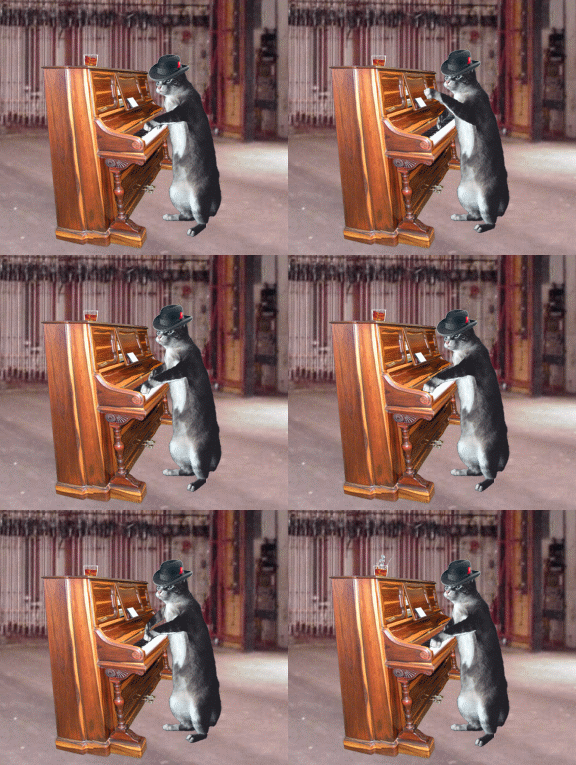
For four years, I’ve brought “Friday Night Tunes” to the DS106Radio stream. It’s built up a small community of folks who tune in to ease out of the week and into the weekend with some music and stories. Making and sharing a set has gone from being a lark to a hobby to my regular artistic practice, and it’s started (or reinvigorated) discussions about music with friends and relatives. But what is the relationship between an ephemeral event and the enduring presence of that event in playlists, recordings, and writings across multiple social media platforms? What’s really a memento, and what’s just digital hoarding? Do I want another website to feed with these records, and does anyone else? Join me for a discussion of the Friday Night Tunes show, a non-technical discussion of how an idea becomes a show, and some thoughts about where it’s going.

The Fediverse Six Months From Now
This discussion will reflect on the state of the fediverse some six months after this abstract was written. Probably, it will depict the fediverse as a response to the abuse of centralized networks such as Facebook and Twitter. It will most likely outline and highlight major differences between ActivityPub-based networks (eg., Mastodon, Lemmy) and AT Protocol networks (Bluesky), and maybe mention things like Nostr and Diaspora, if they’re still around. If anything new comes up, we’ll discuss that too. But of more significance, we’ll look at some of the core issues underlying the fediverse, pointing to solutions if any have been found by then: identification and identity persistence, data and scale issues, and connection and consensus. If Blockchain has risen from the dead we’ll discuss the role it pays in decentralized networks. Also how artificial intelligence can play a role in content creation, selection and filtration. Finally, assuming we still have any, we will look at the key ideas of agency and community underlying the desire to have networks that are not controlled by Elon Musk (or his robot successor) and the role these play in learning and development. Failing any of that, we will discuss why decentralized social networks are illegal and how it’s harmful to the state to have forums where people can discuss the discredited concepts of diversity, equity and illusion, as though the nonsense about diversity making is stronger and more resilient could possibly be true.
Session Resources:
https://fediverse.party/ – introduction to a numb er of popular federated social networks
https://jointhefediverse.net/?lang=en – introduction to the fediverse
https://techcrunch.com/2024/06/25/welcome-to-the-fediverse-your-guide-to-mastodon-threads-bluesky-and-more/ – from TechCrunch
https://www.eff.org/deeplinks/2022/11/fediverse-could-be-awesome-if-we-dont-screw-it – EFF on how the Fediverse could make things better
https://www.downes.ca/post/78050 – Bluesky is more open than you think
I Think We’re All Bozos on This Bus
“Wait a minute, wait a minute. Rolling, take one. {plastic button clicks, bird sings, ice cream truck drives by playing its jingle} And it’s just starting now.
This is the future, yes, live in the future, now…
The future fair: A fair for all, and no fair to anybody. Yes, it’s free! Join the expectant crowd gathering now as we stop here…
Come closer folks, don’t crowd the wheels. …and don’t be afraid little people, cuz we’re just holy grams. So climb on aboard. We’re going inside…”
From intro to “I Think We’re All Bozos on This Bus” by The Firesign Theatre 1971
Learning as Journeys
Learning has always been a journey for me. We say we’re “going” to college for a reason. I became a journeyman glassblower pursuing my craft. My favorite learning journeys are road trips. Whether I’m on two wheels or four, riding trains, hitchhiking, or taking the bus, I always come home transformed.
For me, The Firesign Theatre captured the 1960s and Nixon-era spirit I grew up in through their improvisation and teamwork. I first heard them on Los Angeles’s listener-supported FM station, but they had practiced their craft as sports reporters on AM radio and college radio stations. Their early albums are chaotic because they put them together from live performances, which led to comedy albums and live shows. “I Think We’re All Bozos on This Bus” , the fourth in their improvisational series, is still one of my favorites. I invite you to join me in some serious fun.
Bozo: The Original Media Converger
Before we had theories about transmedia storytelling, Bozo did it. In 1946, Johnny Mercer’s Capitol Records in Hollywood created the world’s first read-along book, ”Bozo at the Circus.” It included a record so children could hear the words while learning to read, with sounds telling them when to turn the page. Apparently, this was the first synchronized content delivery across multiple platforms.
From there, Bozo exploded: more read-along records, phonographs and radios, comic books, toys, radio shows, and in 1949, a TV show on the brand-new KTTV channel 11, Los Angeles’s first TV station. Each platform supported the others. The TV Bozo mentioned the comic book Bozo. The toys looked like the TV Bozo. The records told background stories. Every platform increased every other platform’s value. A capitalist media convergence decades before Henry Jenkins wrote about it.
Then in 1956, Larry Harmon bought the character. Instead of producing one centralized show, he sold franchises. At its peak, 183 local television stations each hired their own Bozo, produced their own show, and created their own local content. Each was authentically local and the concept spread to Canada, Mexico, Brazil, and Australia. Each was recognizably Bozo. Bozo was a distributed network before computer networks existed.
As a kid, I only knew the LA TV Bozo, but Bozo is still going strong. David Arquette bought the rights from Larry Harmon Pictures in 2021, performs at events, and produced a new record this year: Send in the Bozos.
Our Distributed Digital Circus
Now we’re driving our own buses—our blogs, and micro-blogging on federated platforms. Some use WordPress, some use Ghost, and there are Mastodon, Bluesky, Threads, and others emerging with new protocols. The DS106 community at combobulating.net is remixing Reclaim Open from Scotland to LA, Canada to Australia, creating a digital circus where everyone’s contribution has equal access and distribution in the connected network.
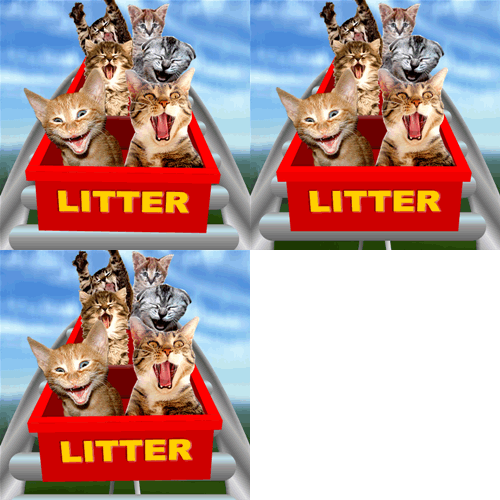
Bryan Mathers’ graphics for Reclaim capture this perfectly, and his Remixer tool lets me create my own bus images for the conference. Each participant designs their own bus. You can make your own at https://remixer.
We’re all bozos on these connected buses, where the 183 local clown shows in 1956 foreshadowed infinite connected blogs in 2025, where media convergence meets distributed learning, where your journey matters as much as anyone’s.
We’re all on journeys. And we’re all figuring out these new learning spaces together. The journey metaphor invites everyone’s stories: How did you get here? What detours changed your plans? Share your stories in the comments and with your own favorite media. I’ll be blogging at https://connectingislearning.
As The Firesign Theatre concluded in “I Think We’re All Bozos on This Bus”; “…the last guy is weird with a beard. {fireworks exploding} Well, the fireworks are over, only the smoke remains…”

LIVE Remix is #4Life: Why we all love the Daily Create and you should too
The Daily Create (TDC) is a creative challenge that is published every day at 5am EST, free and open to all. For many years the link to the day’s challenge was tweeted to the #DS106 hashtag, nowadays it toots to the same hashtag on Mastodon, where we Daily Creators still participate and riff off each other. Some of us complete the TDC every day, others dip in and out from time to time. There are no prizes, and no sanctions. The only rule is to MAKE ART, DAMMIT!
Join us, a group of regular and irregular Daily Creators, as we chat about all things TDC. In this session we’ll talk about many things. Likely topics will be:
- Motivations for participation in the daily create
- The echoes involved when one person riffs on someone else or a previous response
- The theory of remix and bricolage that underpins these types of practices
- What an affinity group is, and how this might explain the connections that are built in remix activities
- How the TDC is a gateway into digital literacy, with free and open resources
We will also each introduce some of our favourite challenges from past daily creates to give a flavour of why we keep returning to participate in the TDC.
Finally, we would like to take the opportunity to issue an open invitation to everyone to join us in the open and participate in future daily creative activities. But beware – #DS106 is #4Life!
Session Resources:
https://daily.ds106.us/
Combobulating in the #WildDS106
What happens when a group of distributed, creative, un-organized remixers decide to collaborate?
Magic, fun and a bit of chaos!
The only thing to expect when working with other remixers is never to know what to expect, as Monty Python might have said.
But what transpires will exceed expectations. Over the last few weeks a group of us have been collaborating to design a new online space to celebrate DS106 (your reflex should be to yell “#4Life” or “Make Art Damnit”) and especially the Daily Create.
As well as writing posts and pages directly onto the website, we are also tagging selected posts on our own blogs to syndicate them so we can collate them on our new web space. Some of us are tagging these blog posts with #WildDS106, others of us are using our regular tag of #DS106 – however people want to have their posts syndicated is up to them – after all this is #DS106 and the only rule is that there are no rules!
In no particular order, here’s what each of us have been doing, and what we want to trumpet loudly about:
- Alan Levine (blogging as CogDogBlog, Mastodoing as cogdog@cosocial.ca) Find hopefully a few comflobuating posts plus more syndicated from my blog tagged #wildds106 and added bits to the Remixers and of course the pet’s corner pages. I was a fan and active participant in the first open ds106 in 2011, taught a few sections, tinkered much on the web sites, and can’t stop doing the daily creates.
- Sarah Honeychurch (blogging as NomadWarMachine, Mastotootling as Nomadwarmachine. Wrote something to explain bricolage and remix, asked questions about socks, has been posting her responses to the TDC on her own blog so they syndicate through. I have been doing the daily create every day for several years now and I am addicted.
- Talky Tina (blogging as TalkyTina, not really saying much on Masto as TalkyTina). Has a page that her TrueFriends added in her honour.
- Kevin Hodgson (blogging as dogtrax in both blog form and Mastodon form). I dove into the #ds106 tag on Flickr, reaching out to people from across the years to see if their connection to Daily Create still has resonance. The Daily Create is my morning routine, along with a cup of coffee (and sometimes, a banana). I’ve been doing it nearly every single day for many years now.
- Wendy Taleo (blogging as Walk My World for this event and generally at Tales in eLearning, Mastodoing as @wentale) I float in and out of the Daily Create over the years. I love that it’s a noticing place, a gentle place and somewhere I can create, connect and learn from. The value in rewilding my connections and learning is learning 4Life. So let’s #WildDS106!
- Mark Corbett Wilson (connectingislearning.com and talkingwithmachines.com, @mcorbettwilson and @faberglas (old) on social media) After a ReclaimTV or Community stream, I canna remember because I have CRS, I talked with Todd and we agreed we had so much fun at the Reclaim Summer Camp we should do something for Reclaim Open. I offered (I know, I know) this spare URL and to slap up a WP site to brush up on the easy stuff (!) after more than a year of federating. That reminds me, the 67 emails and counting we have going is the only thread I have longer than the one I had with Reclaim support after I installed my new self-hosted Ghost in Reclaim Cloud on the 1st day of version 6.0. I digress.
As the noob, I discovered #ds106 after I learned Marshall Ganz’s Story of Self method at a workshop, found the ds center in Berkeley, and trained with Joe Lambert to facilitate digital storytelling. I have used ds106 to learn to use this junk I helped make by working 20 years in Santa Clara, CA. Not a coder, I’m a retired (or unemployable?) high tech glassblower, artist and designer. I spent a few years at UVic’s DHSI and a couple at UMaryWashington’s DigPedLab. Now a Critical Digital Humanist, storymapper, and ds facilitator with StoryCenter.org, I play with all the stuff and sometimes do Daily Creates.
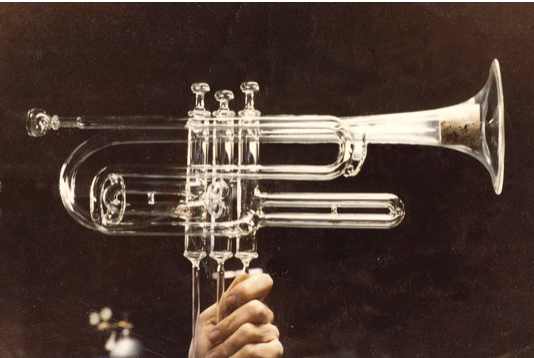
Did someone say trumpet?
- Paul Bond Regularly runs the DS106 course that sits alongside the TDC, blogs at RaptnRent. Makes DS106 socks.
- John Johnston, a bit late to this party/doc. I first mentioned ds106 on my blog in 2011. I most blogged about DS106 on my 106 blog (2011 to 2017). But I’ll put the wild stuff on my main blog. I’ve attempted a few rounds of course and strangely prefer assignments to dailies. Hopefully I’ll blog a couple of #wildDS106 posts over the week and try some/all dailies. I am particularly interested in the do what you want/like in your own way aspect of DS106. It has been of great assistance to me in learning bits and pieces and thinking about learning & teaching.
- Ron Leunissen Still top of the leaderboard for completing daily creates, and also for submitting ideas for activities, though less active since he retired. Has two lovely dogs called Coco and Bella.
- Todd Conaway Blogs at The Whole Classroom. Toots as Todd Conaway. Part of the core team who planning this whole initiative. Wrote the Faculty Blender page.
Want to see more? Head over to our webpages and check them out. Prepare to be combobulated*!
*some of us can never get the word or the domain correct!